In my school days, I volunteered for jobs like the bus monitor, the line guard, class assistant, and government secretary. I loved order and rules and especially wanted to follow God’s truth and proclaim it.
However, as I matured, I witnessed how rules and tight boxes hurt people, how someone’s childhood trauma made them skeptical of authority, how the tone and tenor of my voice determined whether the message of truth was heard. I learned the importance of love. Now I also want to follow God’s command to love others.
The apostle John couples these two themes in his second letter.
1 I love all of you in the truth, and all those who know the truth love you. 2 We love you because of the truth that lives in us and will be with us forever.
3 Grace, mercy, and peace from God the Father and his Son, Jesus Christ, will be with us in truth and love.
4 I was very happy to learn that some of your children are following the way of truth, as the Father commanded us. 5 And now … this is not a new command but is the same command we have had from the beginning. I ask you that we all love each other. 6 And love means living the way God commanded us to live. As you have heard from the beginning, his command is this: Live a life of love.
2 John 1:1–6 NCV (emphasis mine)
John has already told us to “Love in actions and in truth,” (1 Jn 3:18) and echoes the apostle Paul who said, “Speak the truth in love” (Eph 4:15).
First let’s understand what these words mean to John.
In his gospel John records what Jesus said of himself, “I am the way and the truth and the life” (Jn 14:6). In his letters he calls us to obey the teachings of Christ and the apostles (2 Jn 1:9; 4:6; 5:10). Thus, the truth is what the scripture says about Jesus—who he is, how he lived, what he taught, what he requires, and what he’s currently doing.
The bottom line truth for John is acknowledging that Jesus Christ came in the flesh (meaning he was both human and divine) to atone for our sins (1 Jn 4:2–3; 4:15; 5:1; 2 Jn 1:7). Which brings us right to John’s definition of love.
This is love: not that we love God, but that he loved us and sent his Son as an atoning sacrifice for our sins …This is how we know what love is: Jesus Christ laid down his life for us. And we ought to lay down our lives for our brothers and sisters.
Love—agape in Greek—is a fruit of the Spirit (Gal 5:22). (Take note that truth is not.) It is a sacrificial choice we make to give without expecting anything in return, not a feeling we fall into. It loves with sincere actions (1 Jn 3:18). Loving one another is Jesus’s new commandment (Jn 13:34) and John emphasizes this point again and again.1
I most commonly hear these two concepts treated as binary, opposites, or ends of a spectrum. Pastors speak of our tendency to choose one or the other and exhort us to find balance, to hold them in tension.
But I’m not satisfied with this.
I’m on a quest for clarity. And currently theologian N. T. Wright helps me the most:
The great “truth” unveiled in the gospel is that the powerful, redeeming love of God is the motor that drives the cosmos.
If love is the motor in a vehicle, that would make truth the car frame.3 Neither can go anywhere without the other. They are linked. Dependent on each other. Inseparable. Only together can they fulfill their purpose. Truth is head. Love is heart. Truth is the content of beliefs we hold based on Jesus. Love is the character we display based on Jesus.
Problems arise when we misunderstand our definitions.
While we agree truth is found in the Bible, we often interpret it differently. So instead of truth being who Jesus is and what he taught, we include our individual interpretations of secondary issues such as end times predictions, church leadership structures, theological systems, and even political views. We then create rigid rules and strict boundaries around those interpretations. And ultimately we find pastors and authors who only teach our version of “truth” and tell us what we want to hear.
Perhaps we herald truth because we’re products of the Protestant Reformation and European Enlightenment which taught us that information alone will save lives. But this is not what John has in mind when he speaks of truth. John—like his mentor Jesus—knows that complete transformation happens in the heart through the love of the Father, the sacrifice of the Son, and indwelling of his Spirit (Jn 3:16; 6:44; 16:13).
Furthermore, our society also interprets loving others to mean maintaining a comfortable atmosphere where everyone feels mushy feelings of happiness and affirmation, where lying is acceptable if it makes someone feel good. But true agape isn’t shallow or sentimental. It is honest and authentic. This kind of love does not allow abuse or self-destruction but instead gets into the weeds with messy lives to help others grow. Because it seeks the best for another, loving sometimes means saying and doing hard things.
These incorrect definitions lead us to pick our favorite.
Some believers care mostly about the motor—love. In an effort to preserve relationships, they avoid conflict as much as possible and are slow to speak up when they encounter wrongdoing. They tend toward permissiveness, tolerating bad behavior.
Others believers prefer the frame—truth. It motivates their speech, relationships, and lifestyle. These folks tend toward legalism. They are quick to speak up when others aren’t doing it right or they think the truth is being compromised.
We either always correct others when they get it wrong (truth) or we blindly accept anything (love). In an effort to correct this, we try to hold them in balance, asking God for wisdom to know when to speak up and when to remain silent. However, this is not a correct reflection of John’s concepts. Truth is not simply speaking up nor is love only holding my tongue.
When we emphasize love (character) over truth (content), we can be easily deceived or deceive others. When we emphasize truth (content) over love (character), we can be susceptible to idolatry, worshipping power, fame, wealth, and influence. We might then tolerate teachers and leaders who do not display kindness, goodness, self-control, much less love. But the apostle Paul tells us knowledge, reason, and systems of doctrine puff us up while love builds others up (1 Cor 8:1–3). Truth without love is an annoying noise that can sometimes destroy others (1 Cor 13:1–2). We must be clear and honest about who Jesus is and what he taught while at the same time modeling the way he lived.
Many of us assume that our faith is strong so long as we affirm the right ideas about God, but we may give little attention to where the true loyalties of our hearts are directed.
If we separate the motor from the frame, the vehicle cannot move. Similarly, if we separate truth and love, we fail to reach our goal, that of walking as Jesus walked (1 Jn 2:8) in perfect truth and perfect love.
Pastor Ian Simkins beautifully describes what happens when we keep truth and love together. We get “a place where people feel safe and grounded, challenged and embraced. A church where love isn’t shallow but sacrificial, and truth isn’t rigid but relational.”5
My primary method for disseminating truth is my writing. In some ways it’s easier because I’m spared face-to-face confrontation. But it’s actually trickier because I don’t know how my words may be received or understood, or the background and experiences of my readers. It’s also possible for me to never love with actions since I camp out in words.
Therefore, I try to I convey what is clear and obvious in Scripture while also stating my biases when I become aware of them and admitting when I don’t know something. I also offer suggestions rather than definitive commands because I may be wrong. And I always strive to present my ideas in a loving manner, remembering that I cannot see what my readers might face today. I want to invite them back, not shut them down.
Let’s reflect.
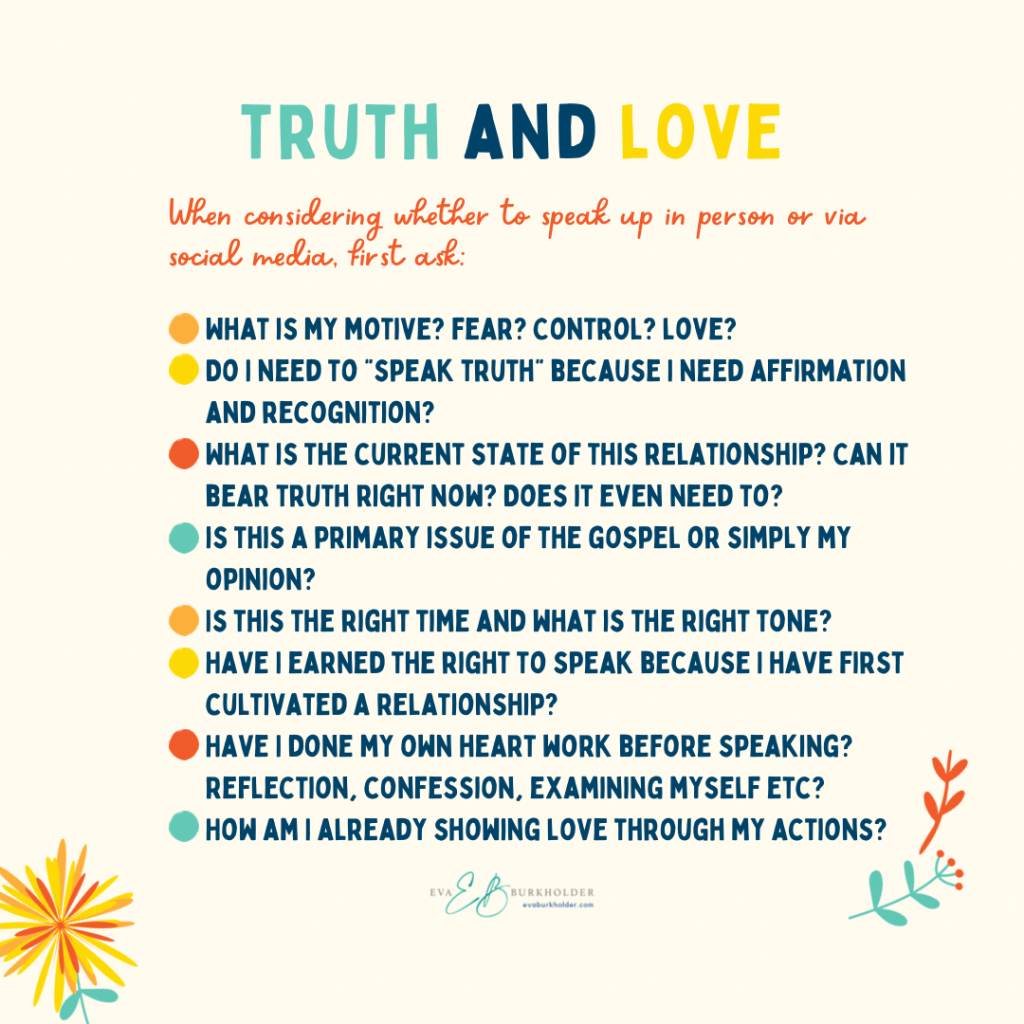
Determine if you most often try to “drive a motor without the frame” or a “frame without the motor.”
Do you tend to avoid speaking the truth at all because you think to do so will threaten your relationships? Do you simply want people to feel good? Are you tolerating bad behavior because you’re terrified to speak up?
Are you too eager to speak the truth and don’t consider its impact? Do you keep repeating the truth because it makes you feel like you’re still in control? Do you love the adrenaline rush that’s associated with feeling right? Do you always need to have the last word?6
Don’t separate truth and love. Instead, abide in Jesus. Stay close to him. If you’re not abiding, if you’re not in community, not seeped in God’s word, not demonstrating God’s love in your actions, first pause, don’t speak.
Then pray. Talk to the Lord. Listen to the Holy Spirit’s prompting. Examine your motives. Do your own heart work first. Ask him to make it very clear if you are to speak and to provide the perfect opportunity to do so. Make every effort to demonstrate agape. And if you are prompted to say something, do it gently, kindly, and with compassion even if the words themselves are tough.
Final thoughts.
As I keep pondering this mystery and tweaking this blog, I can’t shake John’s emphasis on love (nor Paul’s in 1 Corinthians 13). If love is the motor, it drives everything. Love moved God to save the world. Love moved Jesus to give his life. God’s love moves us to love others. But love must be housed in, grounded, and framed by truth in order to get anywhere. Truth ensures that agape—not fake love—moves about in the world. As John said,
And this is his command: to believe in the name of his Son, Jesus Christ, and to love one another as he commanded us … his command is this: Live a life of love.
1 John 3:23, 2 John 2:6
PRAYER
Father God, this is hard and I’m not really sure how to do this well. I need your wisdom in each situation and each relationship to keep truth and love together.
“Truth without love is harshness; it gives us information but in such a way that we cannot really hear it. Love without truth is sentimentality; it supports and affirms us but keeps us in denial about our flaws.” —Tim Keller
“Love without truth is blind, truth without love is empty.” —Joseph Cardinal Ratzinger7
Discover more from Pondered Treasures
Subscribe to get the latest posts sent to your email.


Pingback: Advent 2024 Third Sunday: Truth | Pondered Treasures