God told Moses to build a tabernacle so that he might dwell with them (Ex 25:8). Every element of the structure was designed with that in mind. Each one provides a way for God to be with his people and points to the better way that was to come through Jesus.
The Altar of Sacrifice

The Altar of Sacrifice was the first thing the Israelites encountered upon entering the courtyard of the Tabernacle (Ex 38:1–2). Its purpose was for offering sacrifices both for worship and for the forgiveness of sins (Ex 40:29).
The first offerings were voluntary:
🔥BURNT Offering (Lev 1)—for propitiation and consecration
In this act of worship, a whole animal was offered and completely burned to represent a total sacrifice. This general offering made them right with God through the atonement of sin (1 Jn 2:2) and demonstrated special devotion to God (Rom 6:13).
🌾GRAIN Offering (Lev 2)—to thank God for his provision
This offering from their crops symbolized their commitment to sacrifice their person and possessions to God.
✌️PEACE Offering (Lev 3)—to celebrate the blessings of peace and fellowship with God and one another (Eph 2:13–14).
This offering did not obtain peace with God but rather expressed enjoyment of it (Rom 5:1). It was accompanied by a communal celebratory meal with other worshippers.
The others were mandatory:
🪦SIN Offering (Lev 4:1–5:13)—for purification of unintentional sins as well as sins of omission (Jam 4:17).
⚖️GUILT Offering (Lev 5:14–6:7)—for restitution when they had wronged God or another person. An act of reparation was then required in addition to the sacrifice.
Because God is a holy God, he cannot dwell with sinful people. Through the altar, he provided a temporary cover for sin. They brought an animal from their own flock, put their hand on its head, killed it, and cut it into pieces. Thus the animal symbolically died in their place. Instead of requiring their own blood (Rom 6:23), God allowed the blood of a perfect animal to atone (cover) for sin (Lev 17:11; Heb 9:22). While this system provided a way for God to dwell with is people, it was a temporary and imperfect solution and it pointed to a better way.
Hebrews tells us Jesus is the BETTER sacrifice.
| Tabernacle sacrifices were made year after year as a reminder of sin (10:1, 3, 11) | Jesus sacrificed himself once (9:12, 10:12) |
| They took place in an earthly tabernacle (9:1) | Jesus entered heaven itself appearing face to face with God (9:24) |
| Animals were offered as a substitute for the sin of mankind (9:7) | Jesus offered his own body; he became the sacrifice (9:12, 10:10) |
| They had no external defect (Deut 17:1) | Jesus is totally unblemished (9:14) |
| Their blood gave partial redemption (9:13) | Jesus’s redemption is eternal, for all time (9:12; 10:10) |
| They were unable to cleanse consciences (9:9, 10:1) or remove sin (10:4) | Jesus’s blood obtains eternal redemption (9:12) and purifies consciences from sinful deeds (9:14, 10:22) |
| Everything was sprinkled with blood (9:21) to purify it because blood (a death) was necessary for forgiveness—a life for a life (9:22) | Jesus died to set us free from the penalty of sin (9:15, 10:10) |
But now, once for all time, he has appeared at the end of the age to remove sin by his own death as a sacrifice.
Hebrews 9:26 NLT
🙏🏻 Thank you, Jesus, that today we no longer have to offer animal sacrifices (Heb 10:18) because you became our perfect sacrifice, atoning for the sins of humanity through shedding your own blood in death (1 Pet 1:18–19).
❓Have you accepted his sacrifice on your behalf?
The Basin

The Bronze Basin (or laver) was the second element encountered in the courtyard of the Tabernacle. The necessary bronze came from the mirrors of the women of Israel who served at the entrance to the tent of meeting (Ex 38:8). [Yes, ladies served in the tabernacle!]
Its purpose was for the priests to cleanse themselves so that they would not die when they entered the Tabernacle (Ex 30:18–20).
Our need for cleansing in order to enjoy fellowship with God was provided by Jesus (1 Jn 1:7; 1 Cor 6:11) and his word (Eph 5:26–27). Now we can approach his throne with confidence (Heb 4:16).
🙏Thank you, Jesus, for cleansing me from all sin, for giving yourself to make me holy and blameless.
❓How is God’s word cleansing you?
The Lampstand

After the Israelite priests had made atonement for their sin at the altar and cleansed themselves with water from the basin, they could enter the Holy Place. Drawing back the curtain covering the Tent of Meeting, they entered a dark room lit only by a lampstand.
This ornate piece of art was crafted from 75 pounds of solid gold. It had a central shaft with three branches coming from each side and each cup was shaped like an almond flower about to bloom (Ex 37:17–18). The priests kept the lamps burning continually (Ex 27:20–21) with special olive oil (Lev 24:2).
In scripture, light overcomes darkness (Jn 1:5), conquers fear (Ps 27:1), exposes hidden motives (1 Cor 4:5), and points people to God (Matt 5:16).
The ultimate light is Jesus himself. He is the light of the world (Jn 1:4; 8:12). He leads us out of darkness (Jn 12:46), displays God’s glory (2 Cor 4:6), brings light and truth to those living in darkness (Jn 3:19–21), and reveals the way to salvation (Lk 2:30–32).
🙏Thank you, Jesus, for being our true light that leads us out of darkness into the family of God (Jn 1:9, 12). Teach us to walk in your light (1 Jn 1:7).
❓How is Jesus your light?
The Table of Bread

Across from the lampstand in the Holy Place of the Tabernacle stood the Table of Bread. It was made from acacia wood overlaid with gold with plates and pitchers made of pure gold (Ex 37:10–16). Its purpose was to hold the Bread of the Presence (aka showbread or “bread of face”) which the priests ate before the face of God (Ex 25:30).
This Bread of the Presence was (Lev 24:5–9):
- made of fine flour
- baked into 12 loaves (one for each of the 12 tribes of Israel)
- arranged in 2 stacks of 6 loaves
- freshly set out every Sabbath day
- eaten by the priests only
- a continual food offering to the Lord
The table was first a visual reminder of God’s provision of daily bread, the source of life. And secondly it represented his continual presence with them. Eating the bread in his presence demonstrated the intimate fellowship God had with his people through his covenant.
The table of bread ultimately points to Jesus, the true bread of life, the manna which satisfies our spiritual hunger, gives eternal life (Jn 6:35–58), and provides continual fellowship with God in his new covenant (Mt 26:26–28).
🙏Thank you, Jesus, for being our bread of life and providing the means by which we can always fellowship with you.
❓How do you experience God’s presence?
The Altar of Incense

The third and final piece of furniture in the Holy Place was the Altar of Incense. This small gold altar stood closest to the veil that separated the Holy Place from the Most Holy Place (Ex 37:25–29). The priests burned a special sweet incense on the altar every morning and evening (Ex 40:26–27).
It’s purpose was to give a sweet aroma to God and to counter the odors of the blood from the sacrifices. It was also used during the one day the high priest entered the Most Holy Place. Its smoke concealed him from gazing on God (Lev 16:13).
The incense symbolizes prayers that ascent to God (Rev 5:8; 8:4). The altar of incense also point to Jesus, our High Priest, who intercedes for us before God and presents our prayers as pleasing incense (Heb 7:25).
🙏Thank you, Jesus, for interceding for us.
❓What prayers are you offering up to God?
The Veil and Cherubim

After leaving the Holy Place, the High Priest entered into the Most Holy Place through the Veil. It was made of linen dyed blue, scarlet, and purple with designs of cherubim woven into it (Ex 26:31–33).
No description was given for the cherubim implying Moses knew what they looked like. Most evidence from the ancient world depicts them as lions or bulls with human heads and eagle’s wings.
Just as they protected the Garden of Eden (Gen 3:24), these cherubim stood guard over the entrance to the Most Holy Place. Author Skye Jethani calls them “angelic guardians warning mortals of the dangerous power they were approaching” (With God Daily, Mar 17, 2025).
A similar veil also hung in the temple in Jesus’s day. But instead of keeping us away from God, his death tore the veil in two (Matt 27:51). Now we can dwell in the presence of God (Heb 10:19–20).
🙏Thank you, Jesus, for opening a new and living way for us to enter God’s most holy place—his presence.
❓How can you confidently draw near to God?
The Ark of the Covenant
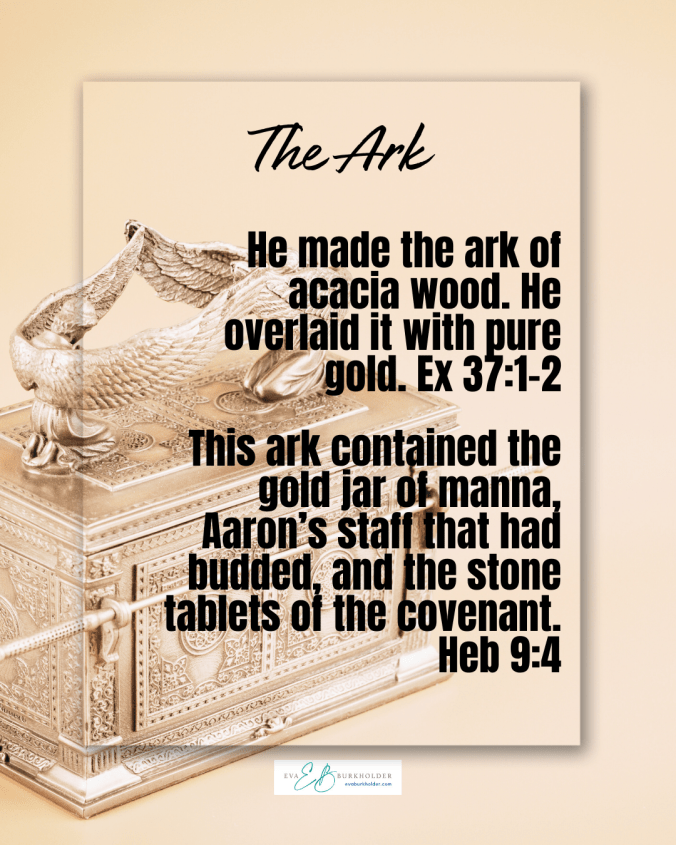
The final space in the Tabernacle was the Most Holy Place. This perfectly square (cube) room contained one piece of furniture—the Ark of the Covenant (Ex 25:10–11).
It was made of acacia wood and overlaid with gold. Its lid was called the Mercy Seat and topped with two gold cherubim facing each other (see next post).
The ark housed the tablets of law (Ex 25:16) representing God’s covenant with his people. More so it was the place where his presence dwelled (Ex 30:6).
Also inside the ark were a gold jar of manna to remind them of God’s provision (Ex 16:32–34) and Aaron’s budding staff to confirm the priest’s authority (Num 17:8, 10).
These elements point to Jesus who is the living bread from heaven (Jn 6:51) and the high priest (Heb 3:1) who mediated a new covenant for us (Heb 9:15). He did this by entering the Most Holy Place once for all with his own blood to secure our salvation (Heb 9:12).
After King Josiah ordered the ark to return to the temple (2 Chron 35:3), there is no more mention of it in scripture.
Jesus, our High Priest, mediates for us a NEW covenant with God (Heb 8:6).
| Old Covenant | New Covenant |
| was weak and useless (7:18) | saves completely (7:25) |
| had faults | is faultless (8:7) |
| was dependent on human obedience (8:9) | is dependent on God’s commitment (8:10) |
| was written on stone tablets | is written on hearts and minds (8:10, 10:16) |
| was reserved for (corporate) Israel | invites all (individuals) to know God (8:11) |
| mandated continual sacrifices in order for sins to be forgiven (7:27) | forgives sins and does not remember them ever again (8:12, 10:17) |
| is now obsolete | will never be replaced (8:13) |
| required many priests | has Jesus—the Great High Priest—as its mediator (9:15) |
| was put into effect with blood from animals in an earthly tabernacle (9:18) | put into effect with the blood of Jesus who sits in heaven (9:24, 28) |
🙏Thank you, Jesus, for mediating a new covenant for us.
❓What does being in a new covenant relationship mean to you?
The Mercy Seat

The lid of the Ark was called the Mercy Seat. It was made of gold with two cherubim on top facing each other. Their heads bowed down toward the lid and their wings stretched forward (Ex 36:6–9).
This “seat” was God’s portable throne (Ps 80:1), his “footstool” (1 Chron 28:2), where he met with them (Ex 25:22) in a cloud (Lev 16:2).
Once a year the High Priest entered the Most Holy Place and made atonement for sin by sprinkling blood on the mercy seat (Heb 9:7).
But this ritual needed to be repeated year after year because the blood of bulls and goats didn’t take away sins (Heb 10:4). So Jesus came to our rescue by shedding his blood once for all time to make us righteous. He is our mercy seat—our sacrifice of atonement.
God presented him as the mercy seat by his blood, through faith, to demonstrate his righteousness, because in his restraint God passed over the sins previously committed.
Rom 3:25 CSB
We can now approach his throne with confidence and find mercy and grace in our time of need (Heb 4:16).
🙏Thank you, Jesus, for being my “mercy seat” and taking away my sin once for all (Heb 9:28).
❓How has God given you mercy and grace when you’ve needed it?
Discover more from Pondered Treasures
Subscribe to get the latest posts sent to your email.

Pingback: Our Great High Priest Fulfills the Day of Atonement | Pondered Treasures