It requires work to accurately mine the treasures in God’s word and determine what the authors intended to communicate. It means not jumping to conclusion or stopping at the first confusing thing we encounter.
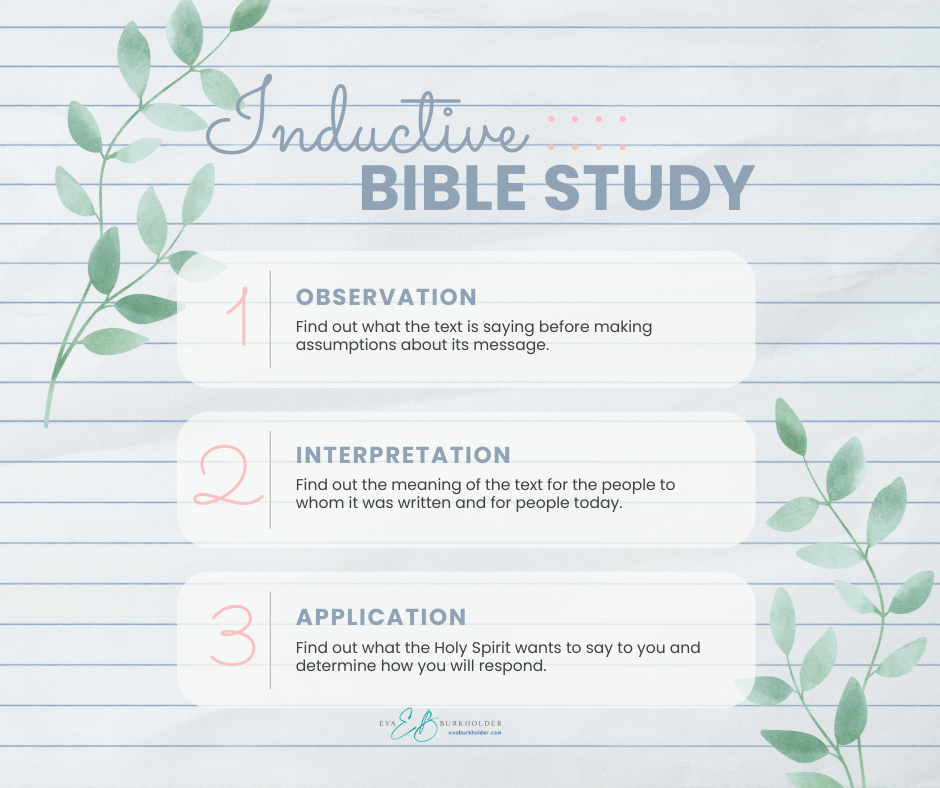
As a young woman I was taught the inductive Bible study method and it has served me well. I love marking the text, doing word studies, and discovering the main principle. Here are the three components:
Observation—What Does it Say?
A. Overview the Text
- Read and reread the text in different translations.
- Note the context, audience, and background information.
- Note the literary genre (poetry, prophecy, parable etc.).
- Mark key and repeated words and phrases.
- Outline the passage.
B. Ask Six Investigative Questions
- Who are the main characters, and how are they described?
- What is happening?
- Where do the events occur?
- When do the events occur?
- Why do the events occur?
- How do the events occur?
Interpretation—What Does it Mean?
A. Determine the Author’s Intended Message
- List any figures of speech, similes, metaphors, etc.
- Look up meanings in a Bible dictionary.
- Look up cross-references.
- What do the terms, phrases, and sentences mean?
- What is the author’s message to his audience?
B. Determine Implications for Today
- What is the main point of the text?
- What are modern equivalents?
- What principles are still applicable today?
- Beware of over-spiritualizing or allegorizing.
Application—How Will You Apply it?
A. Listen to the Holy Spirit
- What does this text teach you about God?
- What does this text teach you about yourself? Others?
- What is God saying to you?
- What might God be asking you to do in response?
B. Apply the Main Point to Your Life
- What will you do because of what you’ve learned?
- Make an action plan (“I will ___________”)
How about you? What do you love (or not) about the inductive method?
Discover more from Pondered Treasures
Subscribe to get the latest posts sent to your email.

Pingback: Find the Bible Study Method That Works for You | Pondered Treasures
I started our two year Men’s Leadership Training and the inductive Bible Study is how our pastor is teaching for us to do
LikeLike
Pingback: Galatians 4:8–5:12: We Are Free in Christ | Pondered Treasures