Having established that we are justified by faith in Christ and not by obeying the requirements of the law, Paul now teaches us, in Galatians 5:13–26, how to live out this new freedom we have in Christ. It’s not freedom to indulge the flesh, but rather freedom to walk by the Spirit.
Previous Posts: Gal 1:1–10; Gal 1:11–2:10; Gal 2:11–21; Gal 3:1–14; Gal 3:15–4:7; Gal 4:8–5:12
Freedom to Love
Paul tells the Galatians they are “called to be free.” But Paul doesn’t want them to use their freedom to “indulge the flesh,” but instead to “serve one another humbly in love” (5:13). In fact, they will fulfill the whole law if they keep the one command to love their neighbor as themselves (5:14, Rom 13:8–10). Biting and devouring one another only leads to destroying each other (5:15).
This verse harkens back to Paul’s statement earlier in the letter that “what matters is faith working through love” (5:6). Now we get a fuller picture of love. Serving—not fighting—each other actually fulfills the law. Because Paul is making his argument from the law, he quotes Leviticus 19:18, the same law that Jesus said was the the second greatest commandment (Matt 22:39).
But I am convinced that using myself as the measure of love falls short because Jesus gave a new commandment—to love others as he loved me (John 15:12) which he modeled by giving his life for me (1 John 4:9–10). I can imitate Jesus’s love because I am free to not simply do what I want but instead to value others above myself (Phil 2:3–8). Because I am God’s beloved child, I can serve others not expecting anything in return, nor to prove my worth, fulfill an obligation, nor gain approval.
How might you love others as Jesus loves you?
Walk By the Spirit
Paul now exhorts his readers to “walk by the Spirit.” This way they will not “gratify the desires of the flesh” (5:16). The flesh and the Spirit are contrary to each other, desiring opposite things. This conflict means the Galatians cannot do what they want to do (5:17, Rom 7:22–23). But if the Galatians are “led by the Spirit,” they are “not under the law” (5:18).
The Greek word for flesh is sarx and refers to “behavior influenced by old patterns of thoughts and choices, apart from dependence on God.”1 Timothy Keller says it is “the sin-desiring aspect of our whole being as opposed to the God-desiring aspect.”2 It is sometimes mistranslated as “sinful nature.” But our sinful nature was crucified with Christ when we believed in him (Gal 2:20, Rom 6:6). Therefore it is the flesh we still deal with. It’s a battle between desires.
This age old battle is debated by scholars so I won’t solve it here. But I believe Paul wants me to focus on being led by the Spirit, to realize that if I walk by the Spirit and let him guide and direct me, I will not do what my old flesh desires or obey my selfish cravings.
What does it look like to walk by and be led by the Spirit?
The Works of the Flesh
Paul now lists out fifteen specific acts or “works of the flesh” as examples. They fall into the broad categories of 1) sexuality—sexual immorality, moral impurity, promiscuity (5:19); 2) worship—idolatry, sorcery; 3) relationships—hatred, discord, jealousy, fits of rage, selfish ambition, dissension, factions, (5:20) envy; and 4) excesses—drunkenness, carousing. Paul warns them, as he has done before, that “those who live like this will not inherit the kingdom of God” (5:21).
- sexual immorality = porneia = sexual intercourse between unmarried people, same gender, or animals (1 Thess 4:7)
- impurity = akatharsia = unnatural sexual practices, uncleanness (Rom 6:19)
- debauchery = aselgeia = uncontrolled lust, licentiousness, lasciviousness, wantonness (Rom 13:13)
- idolatry = eidololatreia = the worship of false gods, pagan religious practices (1 Cor 10:14)
- witchcraft = pharmakeia = sorcery, magical arts, occult practices (Rev 9:21)
- hatred = echthra = hostility, enmity, adversarial attitude (Eph 2:16)
- discord = eris = quarrel, contention, strife, argumentative (Titus 3:9)
- jealousy = zelos = envious and contentious rivalry (Jam 3:16)
- fits of rage = thumos = passion, anger (Col 3:8)
- selfish ambition = eritheia = partisan and fractious spirit; Aristotle used this word to denote a self-seeking pursuit of political office by unfair means (Phil 2:3)
- dissension =dichostsis = disunion, division between people (Rom 16:17)
- factions = hairesis = sects, parties, warring groups (2 Pet 2:1)
- envying = phthonos = coveting, desiring what others have (1 Tim 6:4)
- drunkenness = methe = intoxication (Eph 5:18)
- carousing = komos = orgies, reveling, drinking parties (1 Pet 4:3)
Note that this is not an exhaustive list. Also Paul is referring to habitual sin, not an occasional lapse. Also interesting is that there are no degrees to these fleshly works. Envy is included with pornography. Rage and intoxication are equal desires of the flesh. “The problem is not the body, but our habitual choices not to submit to the Spirit’s authority, direction, and consolation,” writes Melissa Moore3 in her Bible study on Galatians.
What acts does your flesh desire to indulge in? Why?
The Fruit of the Spirit
Instead, the fruit of the Spirt is “love, joy, peace, patience, kindness, goodness, faithfulness (2:22), gentleness, and self control. The law doesn’t prohibit these things (5:23)! Paul emphasizes again that “Those who belong to Christ Jesus have [already] crucified the flesh with its passions and desires” (5:24, Rom 6:6). Paul assumes therefore that the Galatians “live by the Spirit” and so he entreats them to also “keep in step with the Spirit” (5:25). And he offers another exhortation to “not become conceited, provoking and envying each other” (5:26).



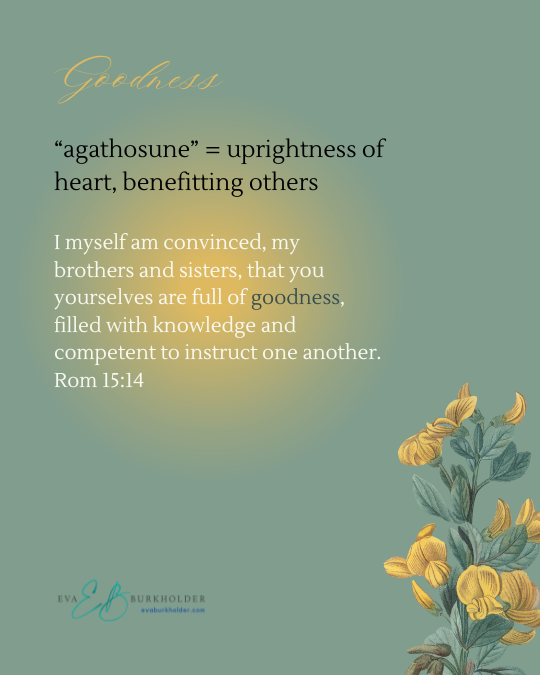
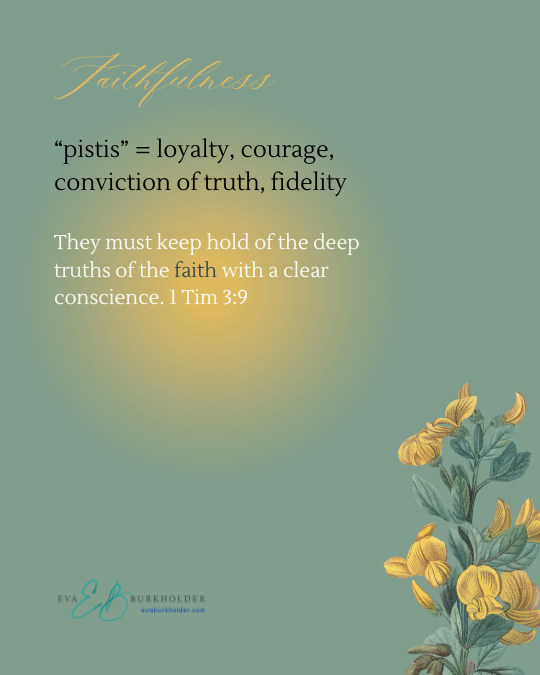

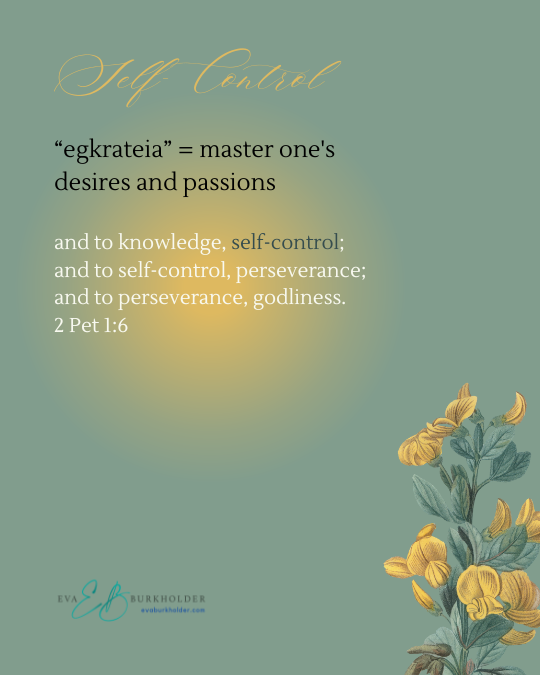
Here Paul uses a singular noun for fruit. Thus a cluster of grapes is the apt visual image. This fruit grows all together and is produced by the Spirit, not me.4 I often try to force myself to be more patient, kind, good etc. but this is actually a work of the Spirit. It strikes me that producing fruit takes time and can only be seen when I look back and realize I have changed. Therefore, I must:
- walk by the Spirit Gal 5:16
- be led by the Spirit Gal 5:18
- live by the Spirit Gal 5:25
- keep in step with the Spirit Gal 5:25
- be filled with the Spirit Eph 5:18
This sounds like abiding in the vine. I abide and God bears the fruit. The apostle Paul tells me that one way to do this is to “have [my] mind set on what the Spirit desires. The mind governed by the Spirit is life and peace” (Rom 8:5–6).
My mother used to tell me to “crucify the flesh”5 when she knew I was exhibiting bad behavior or attitudes. But I think Mom didn’t convey the full picture. I now tell myself, “Your sinful nature has already been crucified with Christ. You are a new creation. Acting this way is not who you are. You are now free to resist those bad attitudes. You can depend on God, not on your old patterns.”
Like the Galatians, I began by the spirit now I must finish by the Spirit (Gal 3:3). To do so, I live by the Spirit, not apart from him.
What growth in spiritual fruit can you recognize as you look back a year, ten, or fifty years ago? How will you chose to live by the Spirit in practical ways?
PRAYER
Holy Spirit, I choose to abide in you and let you lead me. I walk with you, conforming to your will, not going my own way. I set my mind on you, and let you satisfy my needs. Help me to not gratify my fleshly cravings. As I stay connected to you, grow your fruit in me.
- Dr. Amy Cedrone, Galatians: A Faith That Frees, Tuesday Morning Bible Study, Benttree, Carrollton, TX, 47. ↩︎
- Timothy Keller, Galatians for You, 145 ↩︎
- Beth Moore and Melissa Moore, Now That Faith Has Come: A Study of Galatians, 208. ↩︎
- Don’t confuse spiritual fruit with personality. Just because I am a patient person by nature doesn’t mean my patience is Holy Spirit produced. Spiritual fruit is also not the same thing as spiritual gifts which are abilities the Spirit gives us for the purpose of building up the church. ↩︎
- For my deeper dive, read What Does It Mean That Believers Have Crucified the Flesh? ↩︎
Discover more from Pondered Treasures
Subscribe to get the latest posts sent to your email.

Pingback: Galatians 6:1–18: New Creation Living | Pondered Treasures