15 years ago today my mother—Marjorie Jo Loomis Dubert—“graduated to glory” (1928–2010). In her remembrance, I’m sharing a talk she gave in October, 1984 to her colleagues about her experience of raising children in Papua New Guinea. At the time my siblings and I ranged from 29 to 16 years old. I am so grateful I got to call this loving, godly woman my mom. Whenever anyone said, “You’re amazing!” she always replied “I have an amazing God.” Her life and experiences are unique to her and her methods may not apply to every home and family, but I trust you will find something in her story to encourage and inspire you. (I have edited her words slightly for readability and clarity for today’s audience.)

Ray and I arrived in Papua New Guinea (PNG) in February, 1962 with five children. The oldest was going on seven, the youngest was 18 months. The following year I had Eva in a local hospital and then my youngest was born on our first home assignment.
I do know I did a lot of hard work. The grueling every day work that takes a lot of time just to live. I remember when we first moved to Kaisenik village we lived three months in an aid post with three rooms. I washed clothes every day in the river. Even after moving into our own house, I had no one I could hire to help because all the potential young ones were in school. The Lord used this to counter the local belief that western women have money and an easy life.
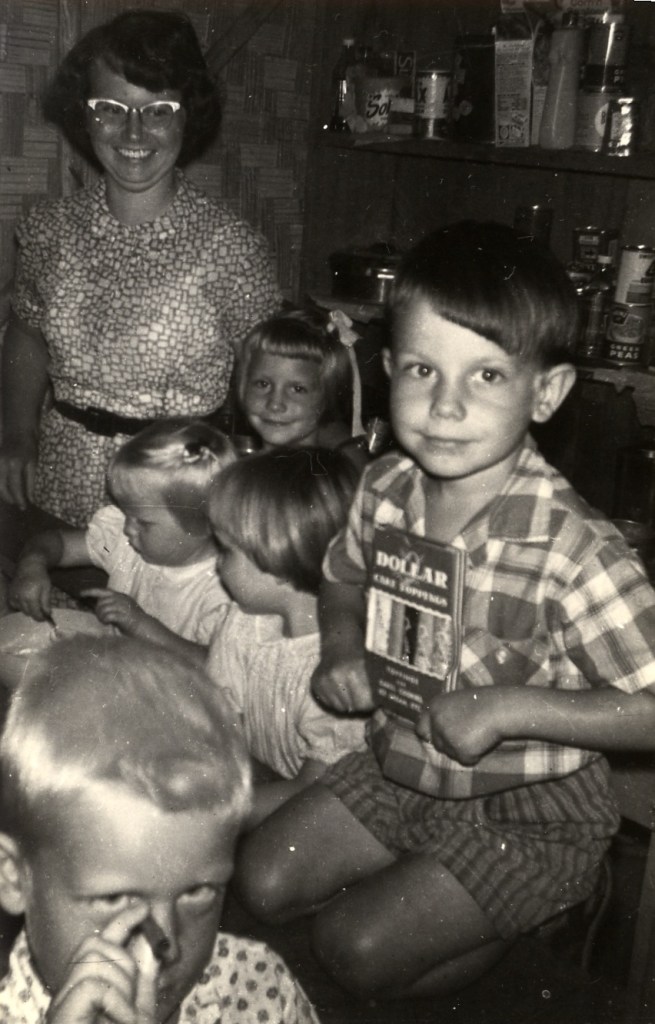
Children thrive on routine. We required them to be at meals even in the village. This meant I had to go find them where they were playing with friends and bring them home. Only to discover they weren’t hungry because they had already eaten!
I routinely put my children to bed early every night at the same time. This meant I had to work at keeping a schedule. A child needs lots of sleep in order to be happy and healthy. Early to bed means early to rise. That meant I had to rise earlier than they did if I wanted time alone with the Lord to prepare my heart.
Early to bed meant no sitting around the fire late at night in order to learn the [local] language, so I had to find other ways of being with the women. The children and I would take walks early in the morning in order to see the women before they went to the garden. (In PNG this was a woman’s daily work—farming, tending, and harvesting their local garden plot.) I often found some women outside standing in the sun discussing the day’s activities.
My children were a real source of ice breaking, love, joy, and laughter. We took walks in the afternoons to encourage playing with the village children. I also found that new mothers stayed in the house for a month so I took the children with me so I could sit with them and practice language, mimicking them. I fit my work around these things.

I not only did a lot of hard work, but I did a lot of trusting, claiming the Lord’s presence and promises that he would never leave me, as well as claiming protection for the children. We had our share of sickness which we had to trust the Lord for healing.
One day Eva was playing with the children and they decided to go swimming. Off came the clothes and she waded across to the other side. The water was a bit swift that day or she lost her balance and she floated down the river. Our local friend was down river washing her clothes and caught Eva. She brought her to me giving me a scolding. We thanked the Lord and her too, by giving her gifts of fish, rice, sugar, and tea.
I also do a lot of praying. I think I know what it means to pray without ceasing. Every moment I was not working on language, helping the children, engaged in conversations, I prayed. I prayed while doing the dishes, washing clothes, making beds, preparing meals. I asked for wisdom for discipline, to solve problems, for patience, strength, grace, for each child’s needs.
I wanted my children to love each other, play together peacefully, to not be selfish, share their toys with villagers, not grab for the biggest piece, to look out for the others’ interests.
The basis of this is a different heart and attitude only Jesus Christ can give, so I dealt with sin at an early age and created a love for Jesus and a desire to please and trust him.
Much of these teachings can be done at meal times or on the spot as they play, including them in your prayer times, teaching them to pray about problems at bed times, praying with them at night or when they wake up afraid. The time to deal with selfishness or quarreling is when you see it.
Underlying all this is obedience. I firmly believed that if my children didn’t obey me, they would not obey Jesus either. Sometimes it has to be unquestioned obedience. How many times should the Lord tell us to do something before we do it? Does the Lord always answer our why? Then don’t always answer your child’s “why” when you say, “Come.” If the children can see your trust and obedience to the Lord, they will learn to do the same.
Then there is the ingredient of love. Discipline in love—actual physical showing of love unconditionally. One son showed a no-care attitude when disciplined. I pled with the Lord for wisdom in how to deal with it. At the next direct disobedience, I disciplined him and then put him on my lap. He struggled to get loose, but I hugged him and kept saying, “I love you.” He melted and hugged me back.
I did a lot of praying, but I also did a lot of resting in the Lord. I rested on the fact that I was redeemed by the blood of Jesus, that my name is written in Lamb’s book of life, that I was where God wanted me to be, that his grace is sufficient.
Living in an animistic society taught me that there is no difference between the secular and sacred. It was not easy in the village, struggling with the stress of learning another language, but life can be hard anywhere, and even when I saw no progress in my task, I had to rest in the Lord. I can only do so much in one day.
If I had a sick child, I didn’t feel guilty that I couldn’t do anything else. If I wasted time, that had to be confessed. But sometimes even after making an honest effort, or even after taking a walk, or sitting with a mother, Satan might come with “You are wasting time. You blew it. What progress did you make?” I would have to tell him to go away. I talked to the Lord about it and left it there. I rested, letting the peace of God rule in my heart.
We had our problems—bed wetting was the worse. I had a number of years of setting the alarm, taking them to the bathroom during the night.
But there also were a lot of fun times. Eating lunch by the river on Saturdays, floating down the river on inner tubes, swimming at the pool with a picnic, Sunday School, house guests, making lifelong friends of the village people.
I am very thankful that my children enjoyed going to the village on holidays. On Friday nights the village kids gathered to sing with guitars, play games, ping pong, and eat pop corn. On birthdays, I’d bake a cake or cookies and share them with whoever was playing with the children at that time.
Christmas was a special time. The kids loved Christmas in the village. The villagers decorated the church with a tree and Christmas cards. We too would do the same with simple homemade decorations or what you can buy in the local stores. We set up our manger scene and attended the Christmas Eve pageant.
The hardest thing was (and remains) separation from the children. We took advantage of the children’s hostels even in primary school. Ray and I felt there were strengths in substitute parents that we lacked. For instance, one couple taught swimming and scripture memorization. The children learned there were lots of ways to do things. They learned how to love others, eat anything put before them, appreciate all cultures, and have less prejudice than we do.
It never is easy, yet the trials they have gone through shaped their lives, strengthened their faith, and helped them find Jesus is a friend. Jesus can meet their needs even as a child.
I have found Matthew 19:29 to be true: And everyone who has left houses or brothers or sisters or father or mother or wife or children or fields for my sake will receive a hundred times as much and will inherit eternal life (NIV).
It is a real joy to receive letters from the kids, thanking us for a Christian home, for the way we raised them and the privilege of growing up in PNG. As they have become aware of the great commission, they realized we obeyed the Lord, inspiring them to do the same.
I did a lot of asking, and he did a lot of answering so really, the Lord gets the credit. He is good. Praise him.
Remembering Mom (on the 10th anniversary)
Wise Words From My Mom (on the 13th anniversary)
Discover more from Pondered Treasures
Subscribe to get the latest posts sent to your email.

This is beautiful, Eva. What a treasure of a heritage you have. I would have loved to sit and linger with your mom, so thank you for sharing this window.
Hugs to you my friend! I hope you are doing well.
Sincerely, Jen Mininger*
Creating safe spaces for women walking through broken places.
Website and Blog – http://www.jenminingerphotography.com http://www.jenminingerphotography.com Hope Layer Podcast by Jen Mininger https://podcasts.apple.com/us/podcast/hope-layer-podcast/id1488376525 Facebook @jenminingerphotography https://www.facebook.com/jenminingerphotography/ Instagram – @Jenminingerphotography https://www.instagram.com/jenminingerphotography/
LikeLike
Thank you Jen. She was a gem.
LikeLike